
Dryer Vent & Air Duct Cleaning in Wellington, FL
Wellington floorplans are wide, and the ductwork inside them is long. We work the runs that turn three or four times before they ever reach outside air.
Distance and Elbows Are the Wellington Variable
On a compact coastal house, the dryer is usually a few feet from an exterior wall and the vent punches straight through. Wellington homes rarely work that way. Laundry rooms sit off a hallway or beside a garage entry, deep inside the footprint, so the duct has to travel — through a soffit, up into the attic, across framing bays — and turn every time the structure gets in the way.
Each of those turns costs airflow. A tight 90-degree elbow can subtract as much effective capacity as several feet of straight pipe, and it gives lint a rough edge to catch on. That is why the same dryer that ran one cycle in a smaller home now runs two here, and why the laundry room feels warmer than the rest of the house by the end of a load.
The other half of the equation is the air conditioning. Big square footage under one roof means long supply branches, oversized returns and, in a lot of Wellington houses, two systems instead of one. There is simply more duct to look at.
- Area
- Wellington & western Palm Beach County
- Typical layout
- Interior laundry, long runs, multiple bends
- Terminations
- Side wall or roof, cleaned where reachable safely
- Hours
- Mon–Thu 7am–6pm, Fri 7am–3pm
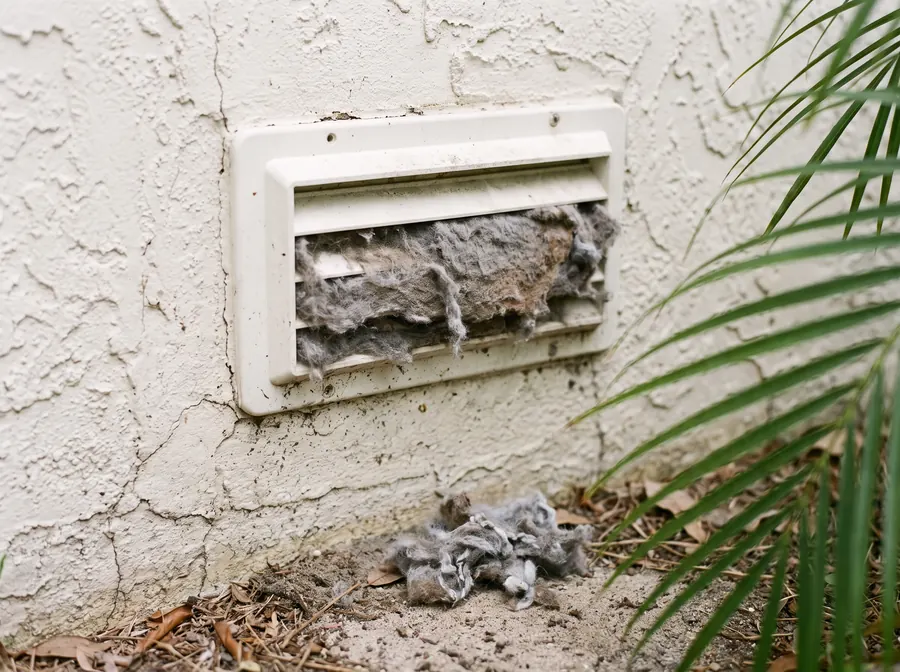
Barn Dust Does Not Stop at the Door
Homes near paddocks, arenas and hay storage deal with a grittier indoor dust load than most of the county.
Arena footing and dry-season sand travel indoors on boots, clothing and open sliders. Once it is airborne in a room, a return grille pulls it toward the air handler. On equestrian-area properties we generally find the heaviest settled debris in the return side and around the blower compartment rather than out at the supply registers — which is exactly where a cleaning has the most to remove. None of that means your house is unsafe; it means the accessible components collect more than a typical suburban home, and they benefit from being looked at on a schedule instead of only when something goes wrong.
Five Services Available Across Wellington
- Dryer vent cleaning for long interior runs, brushed and vacuumed end to end where the duct is accessible
- Blockage removal when a run has packed solid at an elbow, a crushed section or a screened cap
- Air duct cleaning for the reachable supplies, returns and blower area of one or more systems
- HVAC UV light systems, installed and explained strictly per the manufacturer's stated coverage and lamp life
- System sanitization, applied per the product label after cleaning — this is not mold assessment or remediation
Wellington is one stop on a route that runs from Boca Raton to Port St. Lucie — see the full list of cities we cover.
How We Work a Long, Bending Run
Map the route first
Before any tool comes out, we trace where the duct goes and count the turns. On a long Wellington run that map decides which end we work from and how far a brush can realistically reach.
Brush with vacuum capture
A flexible rotary brush is driven through the duct while a vacuum holds suction on the line, so debris broken loose at an elbow leaves the run instead of resettling further down it.
Check the termination
Side wall hood or roof cap, we look at the flap, the screen and the seal when it can be reached safely. A long run with a stuck flap stays a long run with a stuck flap.
Recheck and show you
We compare airflow to the reading we took at the start, reconnect everything and walk you through what came out, with before-and-after photos when conditions allow.
Not satisfied? Tell us within 14 days and we'll re-clean the accessible components at no charge, or refund that service.
Wellington FAQ
My Wellington laundry room sits in the middle of the house. How long can a dryer duct be?
Manufacturers publish a maximum developed length for each dryer, and every elbow subtracts from it — a single 90-degree turn can count for several feet of straight pipe. Interior laundry rooms in larger Wellington floorplans routinely use most of that allowance before the duct ever reaches daylight. We measure the run, count the bends and tell you where the system stands relative to what the appliance was designed for.
Our dryer duct exits through the roof instead of a side wall. Can you still clean it?
Often, yes. Roof terminations are common on Wellington homes where the laundry room has no exterior wall, and they are usually cleaned by working the duct from the appliance end while checking the roof cap where it can be reached safely. Steep tile, wet conditions or a cap in poor repair may limit what we can do from above, and we will tell you that on site rather than after the fact.
We border a paddock and there is fine sand on everything. Does that get into the ductwork?
Arena footing, pasture dust and dry-season grit travel on shoes, clothing and open doors, and a return grille pulls in whatever is airborne in that room. On equestrian-area properties we usually find heavier settled debris in the returns and near the blower than in the supply branches. Cleaning removes what is reachable in the accessible components — it does not seal the house, so seasonal dust will keep arriving.
Our house has two air handlers. Is that one job or two?
Two systems mean two separate duct networks, two blower compartments and two sets of returns, so plan on a longer visit than a single-system home. Tell us how many air handlers you have and roughly where they sit — attic, garage or a closet — when you call, and we will schedule the right amount of time instead of rushing the second system.