
Dryer Vent & Air Duct Cleaning in Port St. Lucie, FL
A city built mostly of newer single-family homes has its own duct habits: interior laundry rooms, long attic runs and caps you cannot see from the driveway. That is the work we come north for.
A New House Is Not the Same as a Clean Duct System
Port St. Lucie has grown faster than almost anywhere in the state, and most of that growth arrived as single-family houses on slab — one or two stories, air handler in the garage or an interior closet, envelope sealed up tight. Tight is good for cooling. It is less good for whatever found its way into the ductwork before you had keys, because there is nowhere for it to go.
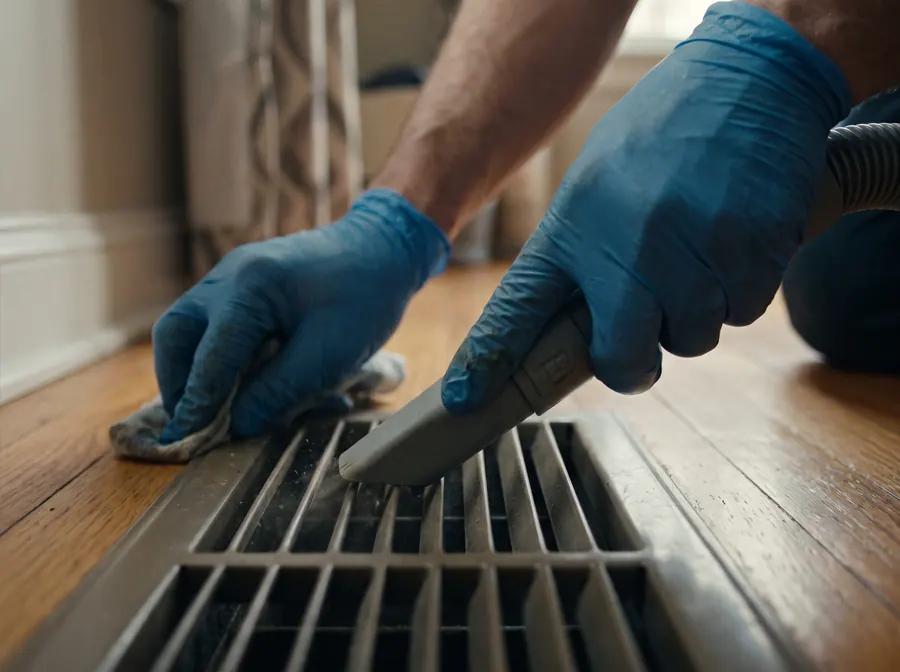
The finishing trades are the usual source. Compound gets sanded, flooring gets cut, and the rough-in trunk lines sit open through all of it. Years later that residue is still in the boots under the registers and along the first few feet of flex. Cleaning the accessible components will not make a used system new, but it removes what can actually be reached — and we photograph before and after so the difference is yours to judge, not ours to describe.
Where These Builders Put the Laundry Room
The second pattern worth knowing here is placement. In a great many of these plans the laundry sits off a hallway or between the garage and the kitchen — interior, not against an outside wall. So the duct climbs into the attic, turns two or three times across the trusses, and terminates at a roof cap or a gable-end hood. Every turn is a place lint slows down and settles.
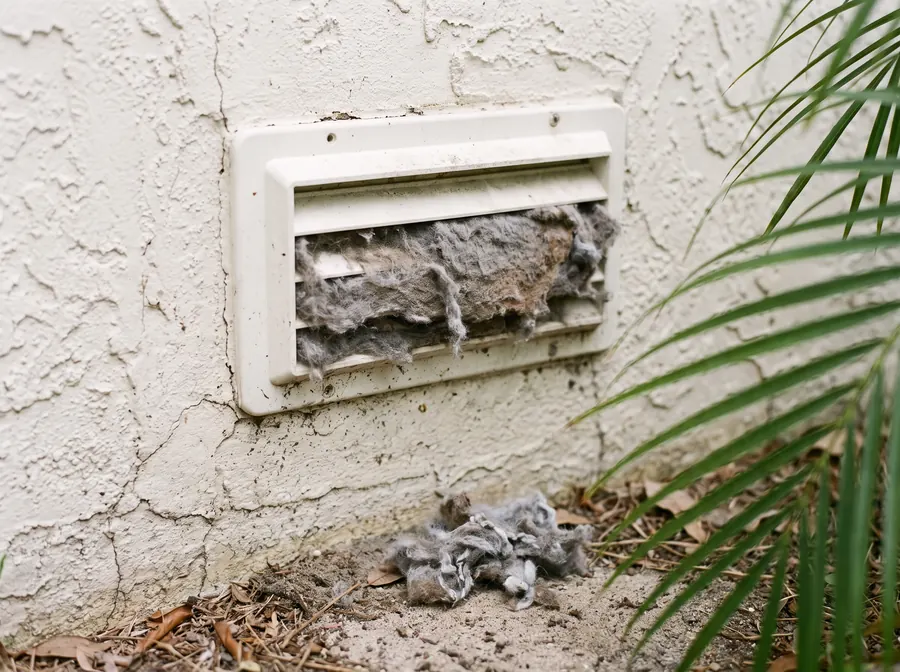
Long runs also make a dryer work harder for the same load. If cycle times have crept up, if the laundry room feels damp when a load finishes, or if the cap outside barely puffs while the machine is running, airflow is telling you something. The answer is not always a cleaning — sometimes it is a crushed foil transition behind the machine, or a fine pest screen doing exactly what screens do. We will tell you which one you have.
The Five Things We Do Here
All five services travel to Port St. Lucie on the same visit if you need more than one.
- Dryer vent cleaning for long attic runs — brushed and vacuumed end to end where the line is accessible
- Blockage removal when a line has packed solid — compacted lint, nesting or a collapsed section
- Air duct cleaning after a build or remodel — accessible supplies, returns and boots
- HVAC UV light systems fitted to your air handler — installed and aimed per the manufacturer's instructions
- HVAC system sanitization as a finishing step — applied per product label after cleaning; this is not mold assessment or remediation
One City, an Enormous Street Grid
Port St. Lucie is platted across a grid so large that two similar-sounding street names can sit miles apart, so we group St. Lucie County work by area instead of crisscrossing town. Give us the actual address when you call and we will slot you into the nearest window. Port St. Lucie is the northern end of the territory we cover from Boca Raton up through the Treasure Coast, so a few days of lead time helps.
- County
- St. Lucie County, the north end of our route
- Hours
- Mon–Thu 7am–6pm, Fri 7am–3pm, closed weekends
- Typical work
- Interior laundry runs, roof and gable terminations, post-build duct cleanups
- Our promise
- Not satisfied? Tell us within 14 days and we'll re-clean the accessible components at no charge, or refund that service.
Browse every city we cover from Boca Raton to the Treasure Coast
Questions About Newer Construction
My Port St. Lucie home is only a few years old — do the ducts really need cleaning?
New construction is not the same as clean construction. Drywall dust, sawdust and insulation fibers get pulled into open trunk lines while a house is being finished, and plenty of it is still sitting in the boots on move-in day. We clean the accessible supplies, returns and boots and photograph before and after, so you can judge the result rather than take our word for it.
Our laundry room sits in the middle of the floor plan. Does that make the dryer vent harder to clean?
Mostly it makes it longer. When the laundry is not on an exterior wall, the duct climbs into the attic and turns two or three times before it reaches a cap. Dryer manufacturers publish a maximum equivalent duct length and every elbow counts against it, so an interior run with several turns can hold lint that a short exterior run never would. We work the run from both ends and tell you plainly if a section is not accessible.
Our dryer vent exits through the roof instead of a side wall. Can you still service it?
Usually, yes. Roof terminations are common on newer single-story homes here. We clean the run from the laundry side and check the cap where it can be reached safely. Screened caps deserve a look either way, because screening catches lint quickly and is a common reason a load starts taking two cycles. If a cap cannot be reached safely, we say so instead of guessing.
Houses are still going up on our street. Should we wait until nearby construction finishes?
If your own home is finished and lived in, there is no reason to wait. Site dust from neighboring lots mostly lands on your filter and around the registers rather than deep inside a closed duct system, so a fresh filter handles most of it. What is worth waiting on is work inside your own house — if drywall or flooring is planned, clean afterward, not before.