
Dryer Vent Blockage Removal
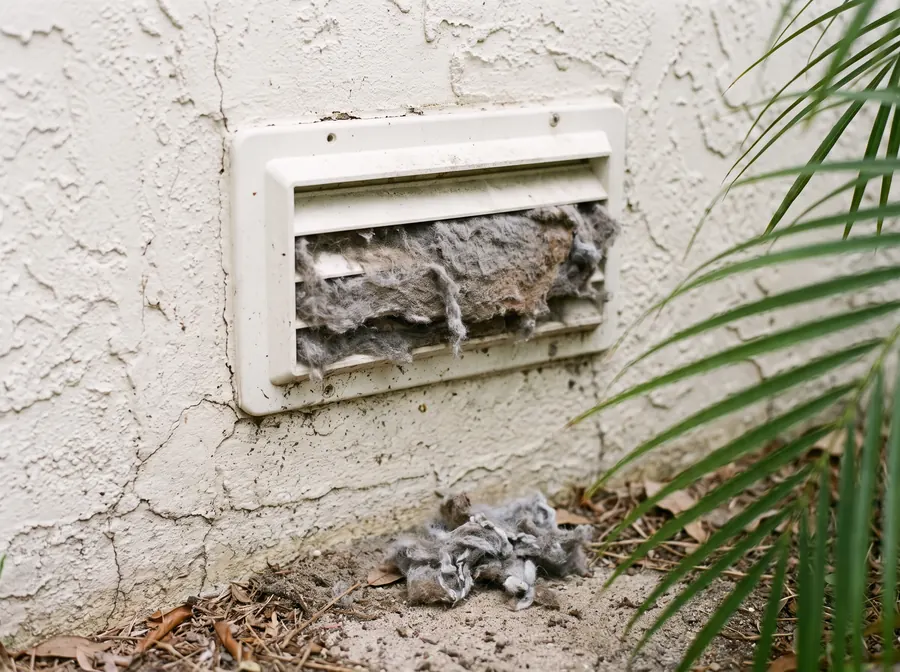
For runs that are packed rather than dirty — compacted lint at an elbow, nesting material at the cap, a collapsed section holding everything behind it.
A clog announces itself in the laundry room long before anyone looks at the duct. We trace the run, find where the air actually stops, clear what we can reach, and show you the airflow reading before and after so the result is not a matter of opinion.
Every load pushes hot, damp air out through the duct, and the lint filter never catches all of it. What escapes rides the airstream until the air slows down — at an elbow, where a flexible connector sags behind the machine, or at the termination flap where the duct meets the outdoors. There the lint settles and stays.
The buildup is self-accelerating. A narrower duct moves less air, less air means lint drops out sooner, and the restriction grows from both ends. That is why a vent can run acceptably for years and then seem to fail in the space of a month: the last stretch of the curve is steep.
In South Florida the damp air makes it worse. Lint that would stay loose and dusty in a dry climate mats together in humidity, so what we pull out of a Palm Beach County duct is more often a felted plug than a drift of fluff.
Any one of these on its own is worth a look. Two or more together, and the duct is almost always the reason.
The single most reliable sign. Damp air that cannot leave the drum has to be reheated, so the machine runs and runs without finishing the job.
Heat and moisture that should be going outside are staying inside instead, usually because they are leaking back out of a restricted duct.
Hold a hand near the termination with the dryer running. Strong, steady air is normal. A weak trickle, or a flap that never lifts, is not.
Lint escaping at the ends means the pathway between them is too tight for it to pass through cleanly.
Stop using the dryer. This warrants having both the appliance and the vent looked at before the next load.
Many machines have a thermal cut-off that trips when exhaust cannot escape. Repeated shutdowns point at the duct, not the dryer.
Clearing a vent without locating the restriction is guesswork. The order below is the same on every visit.
We follow the duct from the dryer to the termination — wall, roof, or soffit — and note the length, the number of turns, and the material. A run we have not mapped is a run we cannot honestly quote.
With the dryer running, we take an airflow reading at the termination before touching anything. That number is what the after reading gets compared against.
A flexible rotary brush is driven through the duct while a vacuum captures what it frees, so the lint leaves the system instead of moving further down it.
We take the airflow reading again, reconnect the dryer, and walk you through what came out, with photos when conditions allow.
A clog that cleans out and a run that is packed solid are two different jobs. We tell you which one you have before any extra work starts.
Length and complexity of the run do most of the work on the number. A short wall vent behind a garage dryer is the simple case. A second-floor laundry venting through an attic to a roof cap is longer, has more turns, and needs roof access.
The other factor is what we find. If the duct is crushed, separated, or the hose behind the machine has collapsed, cleaning alone will not fix the airflow — that becomes repair or replacement, quoted on its own so you can decide.
Serving Boynton Beach, Delray Beach, Boca Raton and 17 more communities.
Airflow at the termination is the quickest test. Run the dryer and hold a hand near the outside hood: if the air is weak or the flap never lifts, the duct is restricting it. If airflow outside is strong but clothes still will not dry, the problem is more likely in the appliance, and an appliance technician is the right call rather than us.
Sometimes, on a short straight run you can reach from both ends. The kits struggle on long runs, on anything with several turns, and on roof terminations, and a brush pushed without a vacuum tends to compact the lint ahead of it rather than remove it. If you have already tried and airflow did not improve, the restriction is usually further in than the brush reached.
Same-day and next-day appointments are often available. Call (561) 884-4648 and we will tell you honestly what the schedule looks like rather than booking a window we cannot hold.
If a restricted duct is what was holding the moisture in, drying times usually improve, and the airflow reading will show you how much changed. What we will not do is promise a number in advance — a worn heating element or a failing moisture sensor produces the same complaint, and cleaning the duct does not touch either one.
It depends on loads per week, the length of the run, and whether anyone in the house dries pet bedding or heavy fleece. Many South Florida homes land somewhere around once a year. We would rather tell you what your airflow looks like at the next visit than sell you a schedule you may not need.