
Ask five companies how often a dryer vent needs cleaning and you will get five numbers, most of them suspiciously round. The honest answer is that it depends on four things, none of which is the calendar — and in South Florida one of them matters more than it does anywhere else.
There Is No Universal Interval
A dryer vent fills up at a rate set by how much air goes through it and how much lint that air is carrying. A retired couple running two loads a week through eight feet of straight metal duct and a family of five running two loads a day through thirty feet with five turns do not share a maintenance schedule, and any company that quotes you one without asking about your run is guessing.
What follows is what actually drives the interval, roughly in order of how much difference each one makes.
Four Things That Decide Your Interval
1. Length and number of turns
This is the big one. Lint settles wherever air slows down, and air slows at every bend. A short wall vent with one elbow behind a garage dryer is forgiving. A second-floor laundry venting up through an attic to a roof cap — thirty feet, four or five turns, with a vertical climb in the middle — is not. Those roof-vented runs need attention noticeably more often, and it is not because anything is wrong with them.
2. How much laundry you actually do
Loads per week is the multiplier on everything else. If your household volume has changed — a new baby, a teenager playing sports, a short-term rental — your interval changed with it, even though nothing about the duct did.
3. What you dry
Heavy fleece, towels, new cotton and pet bedding shed far more than lightweight synthetics. A house that dries dog blankets every week is loading its duct several times faster than one that mostly dries office shirts.
4. What the duct is made of
Smooth-wall metal passes lint along. Ribbed flexible foil catches it in every ridge, and sags between supports so the low points collect more. If your run is foil, cleaning it more often is treating the symptom — replacing the reachable sections with metal changes the interval itself.
The Florida Part
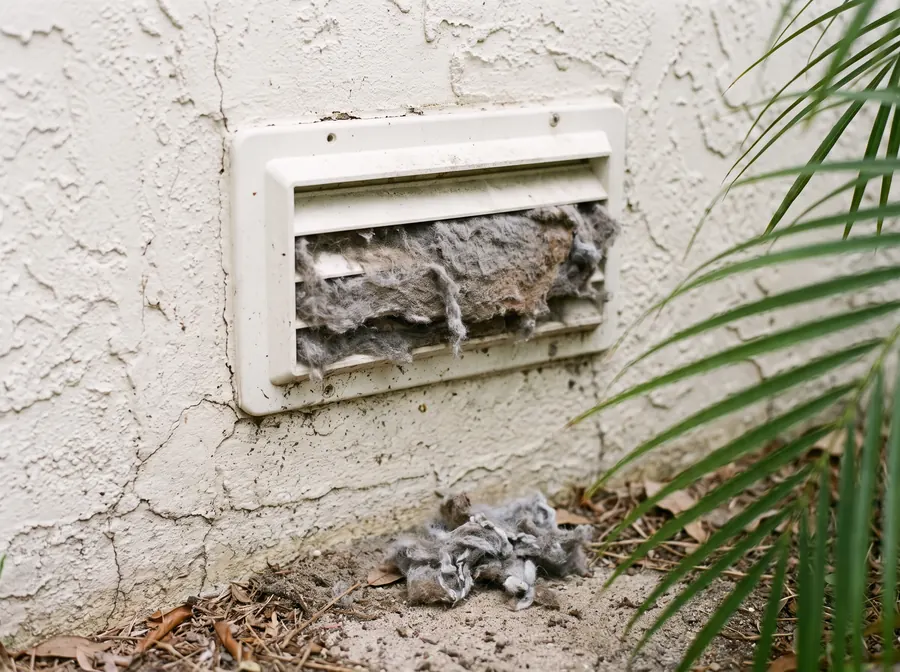
Humidity is why South Florida is not like the rest of the country on this. Lint that would stay loose and dusty in a dry climate mats together in damp air, so what comes out of a Palm Beach County duct is more often a felted plug than a drift of fluff. Matted lint grips the duct wall, resists airflow more per gram, and does not get carried along the way loose lint does.
The practical consequence is that the same house with the same laundry habits will need its vent cleaned sooner here than it would in Phoenix. Many of the homes we service around Boynton Beach and Delray Beach land somewhere around once a year, and the long roof-vented runs out west tend to come up sooner than that.
Signs That Override the Calendar
Whatever interval you have settled on, these mean it is due now:
- Clothes need two cycles to finish one load. The single most reliable indicator there is.
- The laundry room gets hot or humid while the dryer runs. Heat that should be leaving the house is staying in it.
- Weak or no air at the outside hood with the dryer going. Hold a hand near it; the flap should lift and the air should be strong.
- Lint around the hood or behind the machine. Lint escaping at the ends means the middle is too tight to pass it.
- The dryer shuts off mid-cycle. Many machines have a thermal cut-off that trips when exhaust cannot escape.
Any one of those is worth a look. Two together and it is almost always the duct — start at clogged dryer vent.
How to Get a Real Answer for Your Home
Have the airflow measured. A reading at the termination with the dryer running tells you where your run actually stands, which beats any interval someone quoted you. Our airflow test is free, takes under half an hour, and sometimes the answer is that nothing needs doing yet — which we would rather tell you than sell you a cleaning you do not need.
The useful question is not how many months it has been. It is what your airflow reading looks like today compared with what it looked like last time.
Bottom Line
If it has been more than a year, your laundry room runs hot, or clothes are taking longer than they used to, it is worth having someone look. If you genuinely do not know when it was last done, assume it has not been. Book a dryer vent cleaning or start with the free airflow test and decide from the number.